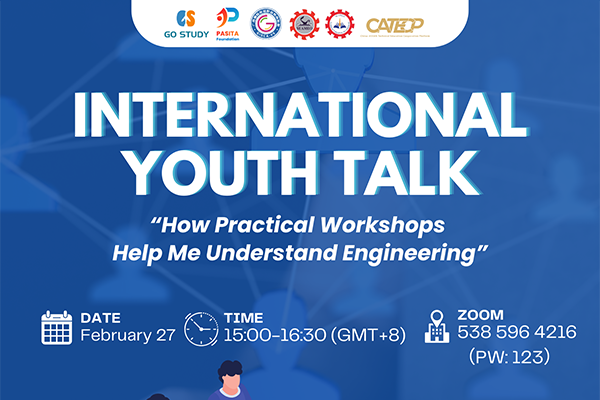

How Practical Workshops Help Me Understand Engineering
#ICT# #IOT#

27th Feb 2026

Clicks:
Academic Hours
2.00hours
Event Date
27 Feb 2026

Speaker

1. Anastasia Kulintsova - Liskinsky Industrial and Transport College - Russia

2. Pavel Baranov - Liskinsky Industrial and Transport College - Russia

3. Anastasia Nikiforova - Liskinsky Industrial and Transport College - Russia

4. Abraham Adrian Jacob - Politeknik Sultan Haji Ahmad Shah - Malaysia

5. Mr. Fahad O. Anggoling - Capiz State University - The Philippines

6. Mr. James Ivan A. Balana - Capiz State University - The Philippines

7. Amiel Abinandana Mulyanegara - Institut Teknologi Nasional (ITENAS) - Indonesia

General Introduction
This edition highlights “How Practical Workshops Help Me Understand Engineering.” In an increasingly skills-driven and innovation-oriented world, engineering education goes beyond textbooks and theoretical lectures. Practical workshops and internships have become essential learning spaces where students transform abstract concepts into tangible understanding. Through hands-on experiments, collaborative projects, prototyping sessions, and real-world simulations, learners are able to bridge the gap between theory and application. From troubleshooting technical challenges to working in teams under time constraints, workshop and internship based learning shapes not only technical competence but also problem-solving skills, adaptability, and professional confidence.
These immersive experiences allow students to better understand engineering principles, industry standards, and workplace expectations in a meaningful and applied way. Through keynote reflections, real-life case studies, and interactive discussions, this session invites participants to explore how experiential learning enhances comprehension and career readiness. The talk examines both the opportunities and challenges of practical engineering education — including access to facilities, mentorship, industry collaboration, and curriculum alignment. Participants are encouraged to reflect on their own learning experiences and consider how institutions and industries, particularly within ASEAN contexts and beyond, can strengthen hands-on training to prepare future-ready engineers.

This Course is for
1. University students and young researchers interested in understanding how practical workshops and hands-on learning experiences enhance conceptual understanding, technical competence, and problem-solving skills in engineering education, particularly for those navigating academic and professional transitions.
2. Undergraduate students and early-career engineering professionals who seek to explore how experiential learning, laboratory sessions, industry-linked projects, and collaborative training environments strengthen confidence, teamwork, adaptability, and career readiness in a skills-driven workforce.
3. Scholars, lecturers, and practitioners focusing on engineering education, vocational training, STEM development, human resource development, and curriculum design who aim to examine the role of experiential learning, industry collaboration, and competency-based training in bridging academia and real-world practice.
4. Globally minded participants eager to gain cross-regional perspectives on how institutions, industries, and training centers — particularly within ASEAN contexts — implement practical workshops to develop future-ready engineers and respond to evolving labor market demands in diverse economic and cultural settings.

Learning Materials

1. Lecture PPT
2. Lecture Video

Supported by

Benefits of Learning

1. Gain insights into current discussions and research on how practical workshops and experiential learning enhance engineering comprehension, technical mastery, and applied problem-solving skills in today’s skills-oriented educational landscape.
2. Understand the impact of hands-on training, laboratory work, industry-linked projects, and collaborative learning environments on students’ confidence, adaptability, teamwork, and professional readiness, particularly for those preparing to enter the engineering workforce.
3. Connect theory with real-world application by reflecting on practical case studies and workshop experiences, exploring how experiential learning bridges the gap between classroom knowledge and industrial practice.
4. Enhance cross-cultural understanding through discussions among students, educators, and globally minded participants, sharing perspectives on how institutions across different countries — especially within ASEAN — integrate practical training to strengthen engineering education and employability.
5. Expand academic and professional networks by engaging with participants interested in engineering education, vocational excellence, and workforce development, fostering meaningful dialogue, collaboration, and knowledge exchange across disciplines and regions.

Courses Videos

Documents
Please log in and download