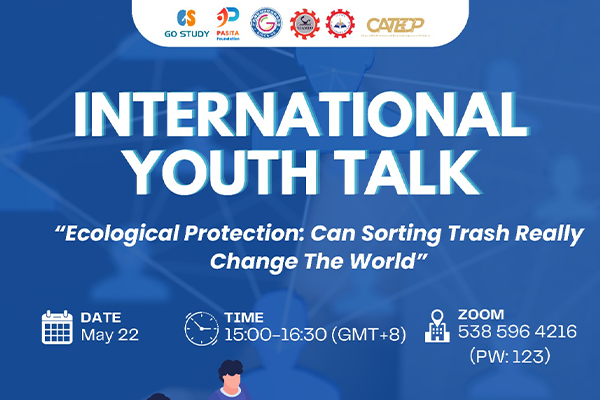

Ecological Protection : Can Sorting Trash Really Change The World
#ICT# #IOT#

22th May 2026

Clicks:
Academic Hours
1.50hours
Event Date
22 May 2026

Speaker

1. Nur Aireen Alya Binti Mohamad Ezrin ShahKerian Vocational College - Malaysia

2. Syahir Syahmi Bin SalehudinKerian Vocational College - Malaysia

3. Nurin Irdina Binti SahrolnizamKerian Vocational College - Malaysia

4. Ray Angilo S. DiazJohn B Lacson Colleges Foundation - Philippines

5. Frenz John G. EstoresJohn B Lacson Colleges Foundation - Philippines

6. Danny Christian L. Jumayao John B Lacson Colleges Foundation - Philippines

7. Naura Aulia NurUniversitas Tanjungpura - Indonesia

8. Muhammad Abidzar JanuartaUniversitas Tanjungpura - Indonesia

9. Faras Dewari MirindaUniversitas Tanjungpura - Indonesia

10. Wang Houng JanthipUniversiti Teknologi Brunei - Brunei

11. Linna NilavongSouphanouvong University - Laos

General Introduction
This edition highlights "Ecological Protection: Can Sorting Trash Really Change The World?" In today’s rapidly growing world, environmental protection has become one of the most urgent global concerns. Waste management is no longer only about keeping spaces clean, but also about creating sustainable systems that protect ecosystems, reduce pollution, and support healthier communities. One simple action, such as sorting trash, can contribute to larger environmental changes when practiced consistently and collectively. From household waste separation to large-scale recycling systems and community-based environmental movements, ecological protection demonstrates how small daily habits can create meaningful impacts.
Through awareness, responsibility, and collaboration, individuals and communities are able to reduce landfill waste, conserve natural resources, and support a more sustainable future for the next generations. Through presentations, case studies, and interactive discussions, this session invited participants to explore whether sorting trash can truly influence environmental change on a global scale. The session also emphasized the importance of environmental awareness, sustainable lifestyles, and collective action in addressing ecological challenges. Participants were encouraged to reflect on their own habits and consider how simple actions can contribute to broader environmental protection efforts, particularly within ASEAN communities and beyond.

This Course is for
1.University students and young environmental advocates interested in exploring how simple ecological actions, such as sorting trash and waste management practices, can contribute to environmental protection and inspire sustainable lifestyles, particularly among younger generations facing increasing environmental challenges in a rapidly changing world.
2.Undergraduate students and early-career professionals who seek to understand how waste sorting systems, recycling initiatives, and community-based environmental movements can shape their perspectives, strengthen environmental awareness, and encourage them to contribute meaningfully toward a cleaner and more sustainable society.
3.Scholars, lecturers, researchers, and practitioners focusing on environmental sustainability, ecological protection, waste management, and sustainable development who aim to examine how collective environmental actions and sustainable practices can address global ecological challenges, while integrating real-world case studies into education, research, and community engagement.
4.Globally minded participants eager to gain cross-regional perspectives on how environmental protection efforts and waste management initiatives across different countries — particularly within ASEAN contexts — contribute to sustainability, ecological awareness, and improved quality of life in diverse social, economic, and cultural environments.

Learning Materials

1. Lecture PPT
2. Lecture Video

Supported by

Benefits of Learning

1.Gain insights into current discussions and initiatives in ecological protection, exploring how simple environmental actions such as sorting trash, recycling, and sustainable waste management can inspire greater environmental awareness, responsibility, and long-term positive change in today’s rapidly developing world.
2.Understand the impact of waste management and ecological protection efforts in addressing real-world environmental challenges, including pollution, excessive waste production, and sustainability issues, while also shaping participants’ perspectives, adaptability, and readiness to contribute to a more sustainable future.
3.Connect theory with real-world application by reflecting on real-life environmental campaigns, recycling systems, and community-based sustainability initiatives, exploring how small daily actions can evolve into impactful solutions that protect ecosystems and improve quality of life.
4.Enhance cross-cultural understanding through discussions among students, educators, environmental advocates, and globally minded participants, sharing perspectives on how ecological protection efforts across different countries — especially within ASEAN — contribute to sustainability, environmental awareness, and societal well-being.
5.Expand academic and professional networks by engaging with participants interested in environmental sustainability, ecological protection, and global development, fostering meaningful dialogue, collaboration, and knowledge exchange across disciplines, communities, and regions.

Courses Videos

Documents
Please log in and download