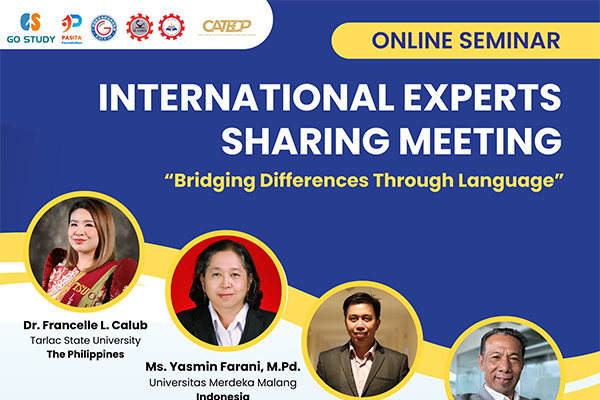

Bridging Differences Through Language
#ICT# #IOT#

07th Aug 2026

Clicks:
Academic Hours
2.00hours
Event Date
07 Aug 2026

Speaker

1. Dr. Francelle L. Calub, Tarlac State University, The Philippines

2. Ms. Yasmin Farani, M.Pd., Universitas Merdeka Malang, Indonesia

3. Dr. Nico Irawan, Stamford International University, Thailand

4. Dr. Rediyono, STIE Pancasetia Banjarmasin, Indonesia

General Introduction
The International Experts Sharing Meeting brings together distinguished scholars, practitioners, educators, and professionals from ASEAN and beyond to exchange perspectives on the role of language in fostering communication, cultural understanding, and meaningful connections across diverse communities. This edition focuses on “Bridging Differences Through Language.” In an increasingly interconnected world, language plays a crucial role in overcoming cultural and social differences, promoting mutual understanding, and building stronger relationships among people from diverse backgrounds. Through effective communication and language learning, individuals are empowered to engage with different perspectives, cultures, and experiences.
The session invites participants to explore how language can serve as a bridge between cultures, communities, and generations. Topics include multilingualism, cross-cultural communication, language learning, intercultural competence, cultural diversity, inclusive communication, and the role of education in fostering greater understanding through language. Through expert presentations, case studies, and interactive discussions, the meeting promotes dialogue, cultural exchange, and interdisciplinary collaboration. It aims to inspire participants to recognize language as more than a means of communication, but as a powerful tool for building empathy, reducing misunderstandings, and connecting people across differences. Ultimately, the session seeks to strengthen collective efforts toward a more inclusive, connected, and culturally understanding society.

This Course is for
1. University students and young researchers interested in exploring how language, communication, and cultural exchange can help bridge differences, foster mutual understanding, and strengthen connections among people from diverse backgrounds.
2. Early-career professionals, youth leaders, and practitioners seeking to understand practical approaches to improving cross-cultural communication, multilingual collaboration, and inclusive communication in academic, professional, and social environments.
3. Scholars, lecturers, and researchers focusing on linguistics, education, communication, international relations, social sciences, and other interdisciplinary fields that examine language, cultural diversity, intercultural competence, and communication across different communities.
4. Globally minded participants eager to gain cross-cultural insights into how language learning, multilingualism, and effective communication can promote empathy, reduce misunderstandings, and build more inclusive and connected communities.

Learning Materials

1. Lecture PPT

Supported by

Benefits of Learning

1. Gain insights into the latest trends, challenges, and opportunities in language, communication, and intercultural understanding from a global and interdisciplinary perspective, particularly in the context of cultural diversity, social inclusion, and international collaboration.
2. Understand how educational, cultural, technological, and socio-economic factors influence language learning, multilingual communication, and the development of intercultural competence across different communities and regions.
3. Connect theory with practice through case studies and expert presentations showcasing real-world applications of language education, cross-cultural communication, multilingual initiatives, and inclusive communication practices that help overcome cultural and linguistic barriers.
4. Enhance cross-cultural understanding by engaging with experts and participants from diverse linguistic and cultural backgrounds, exchanging ideas on how language and communication strategies can be adapted to different local contexts, communities, educational institutions, and professional environments.
5. Expand professional and intercultural networks by connecting with international scholars, educators, practitioners, youth leaders, and stakeholders committed to promoting language learning, cultural exchange, inclusive communication, mutual understanding, and stronger connections across diverse communities.

Courses Videos

Documents
Please log in and download
  • t****l@gmail.com   2026/08/23
    ★★★★★
    Very informative session. Thanks to the organizers and speakers!
  • j****a@gmail.com   2026/08/21
    ★★★★★
    Thank you so much
  • k****8@umak.edu.ph   2026/08/21
    ★★★★★
    very insightful!
  • p****2@gmail.com   2026/08/20
    ★★★★★
    Here is a 50-word reflection you can use: > This course has helped me understand how language, communication, and cultural exchange can connect people from diverse backgrounds. I learned the imp
  • p****9@gmail.com   2026/08/20
    ★★★★★
    very interesting and funning
  • l****5@gmail.com   2026/08/18
    ★★★★★
    Nice webinar. I learned a lot from this.
  • j****l@gmail.com   2026/08/18
    ★★★★★
    An insightful and engaging session on "Bridging Differences Through Language"! The expert presentations offered great perspectives on cross-cultural communication, multilingualism, and how l
  • 4****6@qq.com   2021/07/21
    ★★★★
    very good