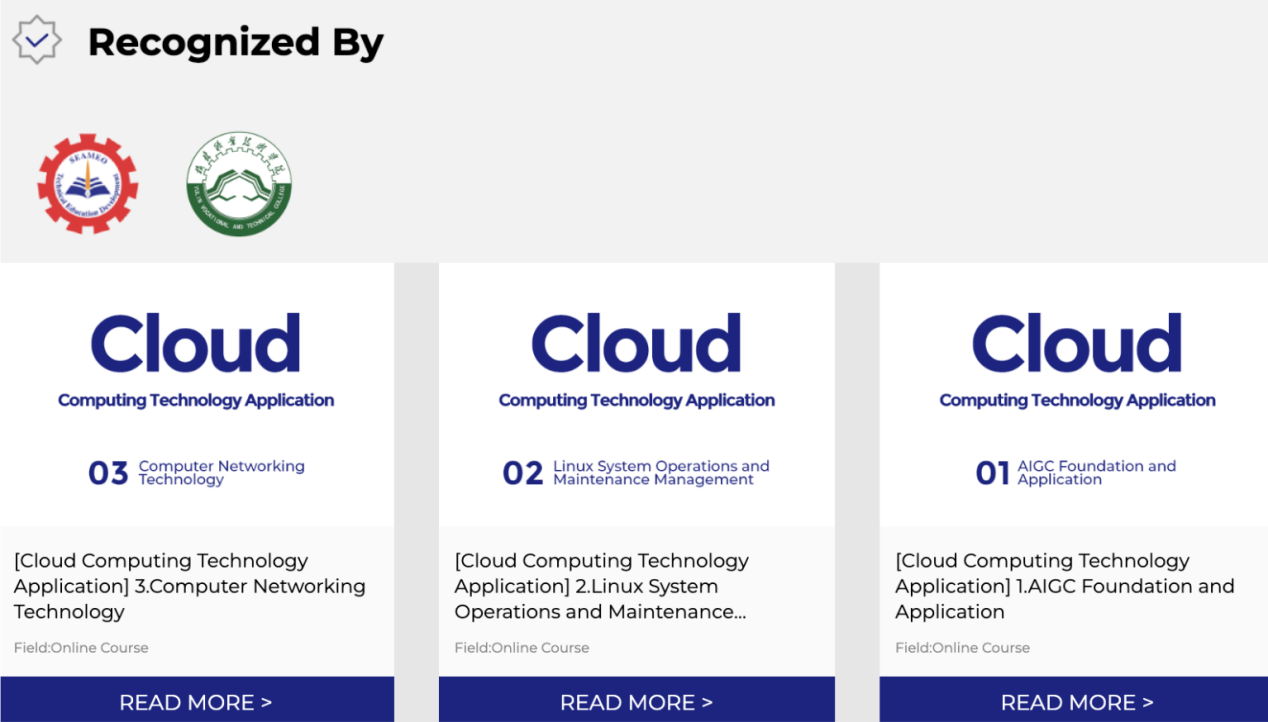



In response to the "China-ASEAN 2030 TVET Flagship Courses Sharing Initiative" initiated by the Southeast Asian Ministers of Education Organization Regional Centre for Technical Education Development (SEAMEO TED), and to serve the human resource needs for international production capacity cooperation in ASEAN countries, Yulin Vocational and Technical College, leveraging its professional strengths, has actively participated in the application and development of the project. Under the cloud computing technology application professional standard, the school has meticulously created three international digital course resources: "AIGC Foundation and Application", "Computer Networking Technology" and "Linux System Operations and Maintenance Management".
The project aims to select high-quality teaching resources from Chinese vocational institutions and develop internationalized digital flagship courses that meet the needs of Chinese enterprises’ international capacity cooperation and align with the industry development plans of Southeast Asian countries. These newly launched courses, as an important part of the project, have been officially released on the China-ASEAN Technical Education Cooperation Platform (CATECP). They will be promoted by SEAMEO TED to vocational institutions and related organizations in ASEAN countries, contributing to the cultivation of technical and skilled talents in Southeast Asia, supporting the localization of employees in overseas Chinese enterprises, and enhancing the international influence of Chinese vocational education.
Through the study of these three courses, students can understand the fundamental theories of generative artificial intelligence, as well as the characteristics and applicable scenarios of mainstream domestic large language models. They are able to design various high-quality prompts in a standardized manner, independently create AI-generated images, videos, audio, and digital human content, integrate various AIGC tools according to practical needs, and complete comprehensive creative and office-related practical tasks; can proficiently use the Huawei VRP command-line interface and eNSP simulation platform, independently configure and debug network devices such as switches and routers, possess core engineering skills in network topology design, IP address planning, VLAN configuration, and dynamic routing deployment, and accurately troubleshoot network faults using common diagnostic tools. are able to independently install and perform basic configuration of the RHEL 9 operating system, proficiently use the command-line interface, and understand how to configure SSH services, adjust SELinux policies, and set firewall rules to ensure system security. These areas of knowledge will help students build a comprehensive knowledge system, lay a solid foundation for subsequent studies or work in the cloud computing technology application industry, and create more possibilities for future career development.