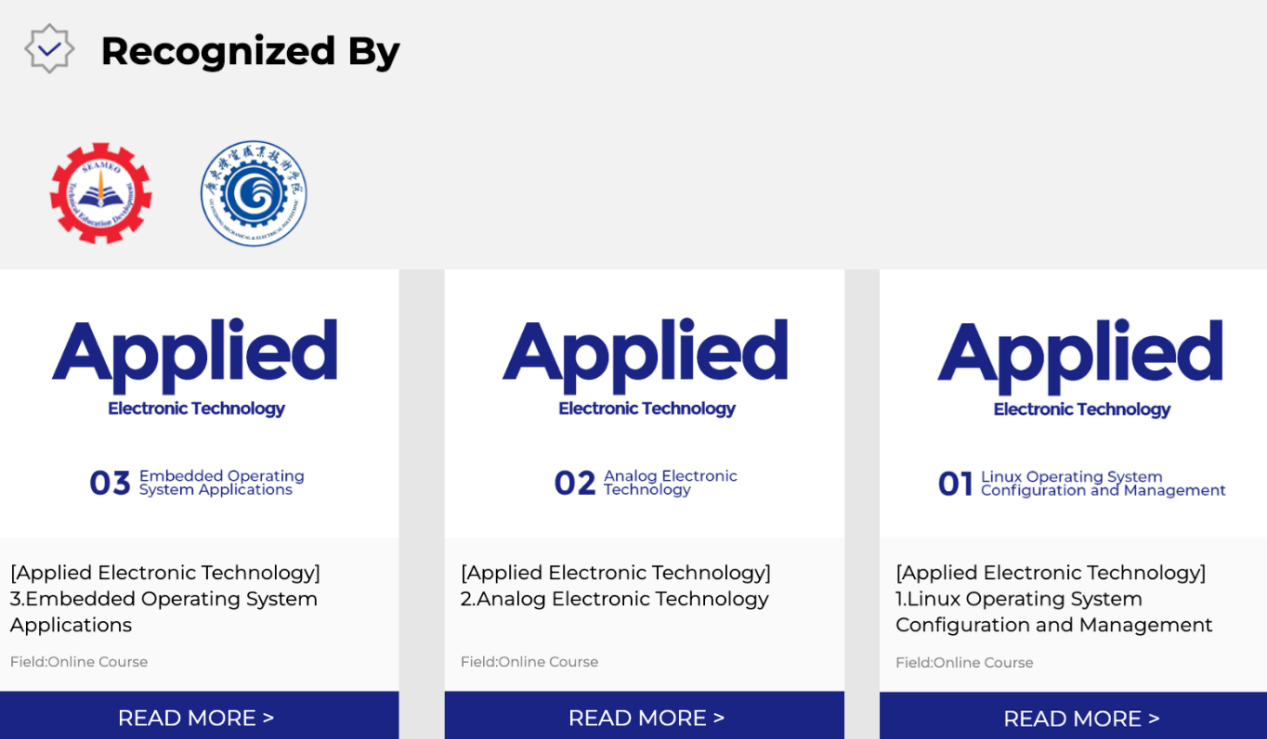



In response to the "China-ASEAN 2030 TVET Flagship Courses Sharing Initiative" initiated by the Southeast Asian Ministers of Education Organization Regional Centre for Technical Education Development (SEAMEO TED), and to serve the human resource needs for international production capacity cooperation in ASEAN countries, Guangdong Mechanical & Electrical Polytechnic, leveraging its professional strengths, has actively participated in the application and development of the project. Under the Applied Electronic Technology professional standard, the school has meticulously created three international digital course resources: "Analog Electronic Technology ", "Embedded Operating System Applications" and "Linux Operating System Configuration and Management".
The project aims to select high-quality teaching resources from Chinese vocational institutions and develop internationalized digital flagship courses that meet the needs of Chinese enterprises’ international capacity cooperation and align with the industry development plans of Southeast Asian countries. These newly launched courses, as an important part of the project, have been officially released on the China-ASEAN Technical Education Cooperation Platform (CATECP). They will be promoted by SEAMEO TED to vocational institutions and related organizations in ASEAN countries, contributing to the cultivation of technical and skilled talents in Southeast Asia, supporting the localization of employees in overseas Chinese enterprises, and enhancing the international influence of Chinese vocational education.
Through the study of these three courses, students will master the characteristics of core components—such as diodes, transistors, and integrated operational amplifiers—as well as the operating principles of typical analog circuits; they will be able to independently interpret circuit diagrams and utilize simulation software for circuit design and verification; they will be capable of reading electrical schematic diagrams, wiring diagrams, and electrical component layout diagrams; they will become familiar with the architecture and operating mechanisms of the RT-Thread embedded real-time operating system, as well as the underlying principles of basic I/O, master practical skills in thread scheduling, inter-thread communication, and peripheral driver development, as well as the corresponding programming methods; they will master fundamental Linux system operations, including system installation, file directory management, and text editing and processing; they will be proficient in system administration tasks such as user and group management, permission configuration, and sudo privilege escalation; and they will possess a strong awareness of rigorous operational and maintenance standards, excellent teamwork skills, and a commitment to continuous technical learning. These areas of knowledge will help students build a comprehensive knowledge system, lay a solid foundation for subsequent studies or work in the applied electronic technology industry, and create more possibilities for future career development.